The Floor Beneath the Instability
A sidebar from Divide by Zero, by Roberto Mas
The original account, dated 19 October 2026, described two runs of the same program that began from fields that were identical to the last bit. The program simulated the Gierer–Meinhardt activator–inhibitor equations, a model in the tradition of Turing’s pattern-forming systems, on a grid of 64 by 64 cells. Every cell held the same values, the uniform state, except for a small smooth ripple at the center, 0.000036 high.
A linear stability calculation, of the kind Turing developed in 1952, predicts unstable spatial modes near the uniform state. A suitable small disturbance should initially grow by a factor of e about every 26 model-time units. That local prediction does not itself describe the later nonlinear pattern.
The account reported that the first run developed spots by time 244.
The second run differed in one setting. It advanced the clock in steps a quarter as long, a usual way to reduce time-discretization error. The account reported that at time 1,500 its field was still nearly flat, and the ripple at the center was exactly the height it had started at, to every stored digit. Initial linear theory predicted growth, not this unchanging disturbance. Nothing flagged it. The program reported a calm field, in the same format it reported everything else.
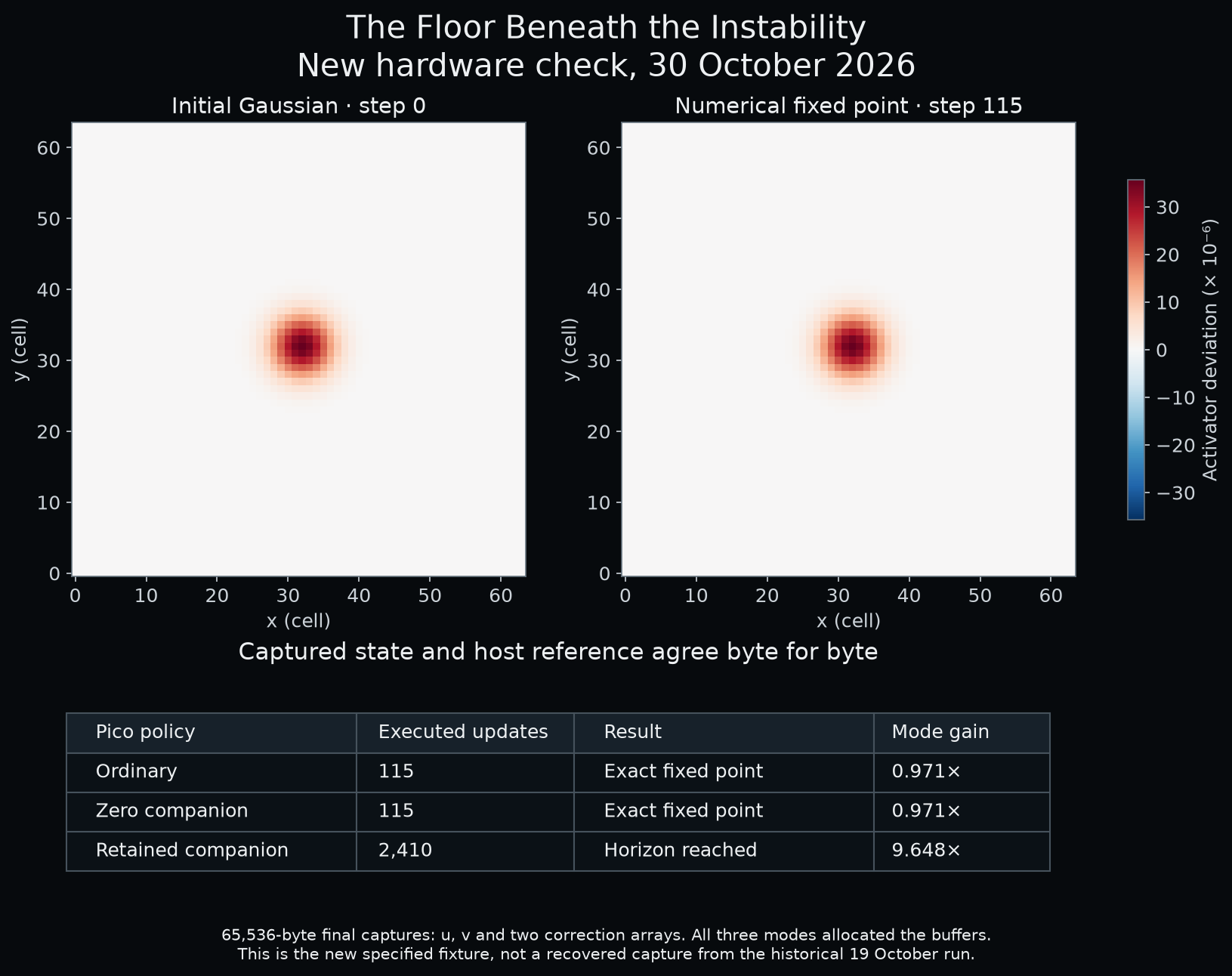
Added 30 October 2026: a later hardware check with newly specified starting fields. Both panels show activator deviation from a uniform twin on the same scale. The original and zero-companion modes froze after 115 updates; retaining corrections restored growth. The complete captured state is 65,536 bytes, including the 32,768-byte correction allocation. See What the Machine Kept for this follow-up and its limits.
Half a step
The program stored each value as a 32-bit float, with 24 binary digits of precision. Near the uniform activator level, 1.525, the gap between one storable number and the next is 2^-23, about 0.00000012. That gap is called a unit in the last place, or ULP.
A useful approximation treats one unstable mode as a growing scalar: its increment is its amplitude times the growth rate times the timestep. If an addition to a stored value is smaller than half the local spacing, round-to-nearest can return that same value. In the coupled grid, actual cell increments depend on both species, diffusion and other rounding. A fixed point requires the entire state to return unchanged.
So there is a floor. A scalar half-ULP estimate suggests an amplitude scale below which growth may be lost:
δ* = ULP ÷ (2 · σ_max · Δt)
Here σ_max is the fastest growth rate from the stability calculation and Δt is the length of a step. For the first run the floor was 133 ULP. For the second, with steps a quarter as long, it was 530 ULP. The ripple was 300 ULP high, above one floor and below the other.
The formula is a modal heuristic, not a sharp boundary or a theorem for the coupled grid. The original account reported that, across three step lengths, ripples at 1.2 times this estimate stayed frozen and ripples at twice it grew, at 85 to 91 percent of the predicted rate. Those observations bracket behavior; they do not measure an exact threshold. The estimate itself doubles each time the step is halved.
More careful, less hearing
The ordinary instinct runs the wrong way here. Shorter steps cut the error of approximating a smooth change by a staircase, and textbooks recommend them. They also cut the growth added at each step, while the rounding gap stays the same size. Each halving of the step doubles the amplitude scale suggested by the heuristic. The exact behavior still depends on the disturbance and arithmetic policy.
Wider numbers lower the floor without removing it. A 64-bit float has a gap about 540 million times smaller, so the same field in double precision would hear ripples hundreds of millions of times fainter. It would still be deaf below its own floor.
None of this is new in kind. Small increments lost against a large running total motivated compensated summation, including Kahan’s 1965 method. Weimar (1997) describes spurious steady states near stable and unstable states in reaction-diffusion calculations, and explains how smaller timesteps can produce them. Croci and Giles (2020/2022) analyze rounding stagnation in PDE time stepping. Here that established problem suppresses the growth of an unstable spatial disturbance. An exact fixed point of the numerical update is not evidence that the continuous equilibrium has become stable.
Which machine this is
Of the Coda's three machines, this is the Pentium. It does not refuse. Asked whether the field will form a pattern, it answers no, plainly, and the answer looks like every other answer it gives. No NaN is needed for this failure: finite rounded operations can return a misleadingly quiet field. The tests check finite values and reported failures, not floating-point exception flags or complete IEEE 754 conformance.
The check that caught it was Nicely's. A second run, built differently and asked the same question, disagreed. Here the second machine did not need to be a second chip: the same program with a different step length was enough, because the floor moves with the step while the physics does not. Numerical answers normally depend on the timestep. A qualitative reversal of this kind calls for convergence and precision checks before the quiet field is interpreted as a property of the equations.
The program can also carry a warning about this risk. From σ_max, the timestep and the stored value, it can estimate δ* and compare it with the disturbance. Turing Bench displays such a heuristic warning. It is a diagnostic prompt to test further, not a validated detector of every frozen state.
The standard, applied
What is unknown. Whether a given quiet numerical field reflects the modeled dynamics or the loss of increments in its update rule. These tests do not measure physical chemistry or morphogenesis.
Which framework makes it unknown. Fixed-width floating point, rounded to nearest, combined with an explicit step that adds growth in small increments. Change either one and the floor moves.
What would change the judgment. A convergence and precision comparison; a changed disturbance; an exact complete-state fixed-point check; or a compensated update compared with a wider reference. The δ* warning is a reason to investigate, not decisive evidence by itself.
Status, updated 30 October 2026. The historical account reported three step lengths in one JavaScript engine. Subsequent specified controls reproduced rounding-dependent behavior on physical RP2040 boards. A new Pico/VAIO comparison then recovered growth by retaining update remainders and verified complete-state byte parity. Its single long hardware recovery fixture and finite horizon are documented in What the Machine Kept. No new priority claim is made for rounding stagnation, compensation or the half-ULP argument.
Source note (for Notes on the Sources)
The original account reports runs made on 19 October 2026 with Turing Bench, a browser reaction-diffusion simulator, and its headless twin under Node 22 (V8 engine). Model: Gierer–Meinhardt with production ρ = 0.1, activator decay μ = 0.08, inhibitor decay ν = 0.12, basal source 0.002, no saturation; diffusion 0.08 (activator) and 3.2 (inhibitor); 64 × 64 periodic grid; nine-point Laplacian; explicit Euler; fields and Laplacian buffers stored as binary32, with JavaScript/V8 expressions evaluated in binary64. This distinction matters: it is not a binary32-at-every-operation experiment. Linear stability gives σ_max = 0.0379 per time unit and a fastest wavelength of 13.3 cells. Disturbances were Gaussian ripples of width 3 cells added to the uniform state and compared against an unperturbed twin run.
The table below preserves the historical account’s reported observations; it is not a newly verified measurement of an exact boundary.
| Step length Δt | Heuristic scale | Reported frozen at | Reported grew at | Reported growth |
|---|---|---|---|---|
| 0.0996 | 133 ULP | 1.2× floor | 2× floor | 0.91 × σ_max |
| 0.0498 | 265 ULP | 1.2× floor | 2× floor | 0.88 × σ_max |
| 0.0249 | 530 ULP | 1.2× floor | 2× floor | 0.85 × σ_max |
The 300-ULP ripple of the opening: spots by time 244 at Δt = 0.0996; unchanged to the last bit at time 1,500 at Δt = 0.0249. The historical account named exp4.js and exp6.js, but those standalone files were unavailable during this review. The original timings and threshold table above are preserved as reported, not represented as newly independently verified. The later harness uses the preserved solver with new specified Gaussian fixtures. Its captured initial/final arrays, hashes and horizons are available in the follow-up evidence record. This review also replaces the earlier unchecked literature note and narrows “stability” to the demonstrated numerical fixed point.