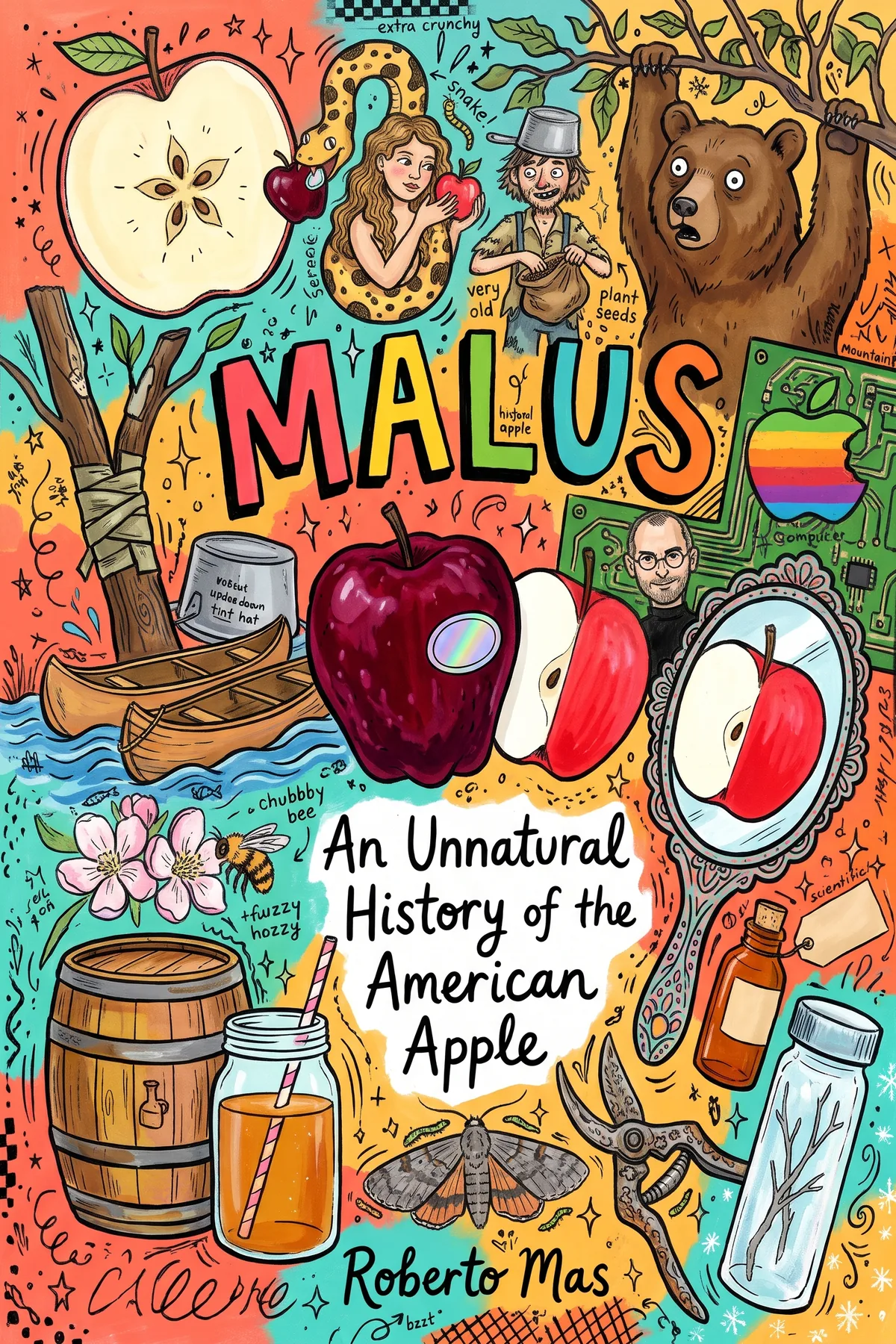
MALUS
An Unnatural History of the American Apple, by Roberto Mas
Free. No sign-up. Copy it, share it, adapt it.
Download PDFDownload EPUBDownload Word
Start with the seed, because nobody else does.
Cut an apple across its equator instead of pole to pole and the core turns into a five-pointed star. Five chambers, each holding one or two brown teardrops. Every one of those seeds is an apple that has never existed before and, almost certainly, never will. We eat around them. We flick them into the sink. An orchard, any orchard, anywhere on earth, is a place where five or ten new answers per fruit are produced every autumn and then thrown away on purpose, because the question was settled long ago by somebody holding a knife.
That is the fact this book hangs from, and I want it on the table before the Devil shows up.
Plant the seeds of the best apple you ever ate and you will not get that apple. You will get its children, and its children will be strangers: small, sour, bitter, mealy, astringent enough to turn your mouth inside out. Old orchard hands called them spitters. One seedling in some large number, and growers argue about how many zeros belong on it, will be worth eating. The rest are firewood and hog feed. The apple in your hand is not a kind of plant in the way a carrot is a kind of plant. It is one individual tree, discovered once, in one place, by one lucky person, and then cut into pieces and stuck onto other trees’ roots for as long as people have cared to keep doing it. Every Granny Smith is the same tree. Every McIntosh is the same tree. If you have eaten a Red Delicious, you have eaten a piece of a single organism that sprouted where it wasn’t wanted on a farm in Iowa around 1870, and that the farmer, by his own account, twice tried to kill.
So the fruit that Americans treat as the plainest, most wholesome, most self-evident object in the produce aisle is in fact a technology. It is a way of stopping time. Somebody liked something once, and we have been photocopying it ever since.
I find that funnier and stranger than anything the apple has been made to symbolize, and it has been made to symbolize nearly everything.
Contents
A Note on Method opens the book and A Note on Sources closes it. Between them, eighteen chapters and three interludes.
Part I: Seed
| Chapter | Narrated by |
|---|---|
| 1. The Kernel | Roberto Mas |
| 2. The Bear’s Orchard | Roberto Mas |
| 3. The Babeldaemon | Cody Wong |
| 4. Every Tree Is Two Trees | Roberto Mas |
| 5. A Honeybee | a honeybee |
| 6. Chapman’s Canoe | Roberto Mas |
| Interlude: Appleseed® | Johnny Appleseed, the registered mark |
| 7. A Haudenosaunee Orchard, 1779 | the orchard at Kendaia |
Part II: Graft
| Chapter | Narrated by |
|---|---|
| 8. Malum | Satan |
| 9. The Vine Has Some Notes | Jesus |
| 10. Eve | Eve |
| 11. A Barrel of Hard Cider, 1840 | a cider barrel in a Massachusetts cellar |
| 12. Delicious | Roberto Mas |
| Interlude: The Fairest | the Queen |
Part III: Fruit
| Chapter | Narrated by |
|---|---|
| 13. Pruning | the Gravensteins of All One Farm |
| Interlude: Scion | the language model that was asked to be Steve Jobs |
| 14. Open-Pollinated | an Apple-1 |
| 15. Worms | the worm |
| 16. A Codling Moth | a codling moth |
| 17. A Vial of Buds in Liquid Nitrogen | a vial of dormant buds, Fort Collins, Colorado |
| 18. Geneva | Roberto Mas |
This edition
Free digital edition, 19 November 2026. About 83,000 words, 247 pages in the PDF. The EPUB is for e-readers and phones, and the Word file is the manuscript, double spaced.
Copyright © 2026 Roberto Mas. Released under the MIT License; the full text is on the copyright page of each file.